In an effort to continue my journey to find my favorite song, I’m participating in the 30-Day Song Challenge for the month of June. And I hope that you, my readers, will also do so. I must admit, this is gonna be very difficult for me. My iTunes alone has over 5,000 songs and that’s the sum from when I stopped my musical piracy, I’ve heard SO MUCH MORE music since then. Some of the days might have multiple songs, but for the most part, I think that I can simplify my choice.
Comment your favorite songs for the days as we go through the month. Happy listening!
Every day I get on Instagram or read through Google News and I see a new story about the oppression of the colored race. It has become a social norm throughout history and to me, that is the real tragedy. It saddens me, and I can’t imagine how watching these occurrences every day doesn’t sadden us all. I find that through music, I am encouraged to look beyond the stress and inspired to carry on. That’s the power of music and the power of black music speaks specifically to our strife.
1.James Brown – Say It Loud, I'm Black and I'm Proud
One of the most significant songs in the Black community, Brown composed this number to strengthen black pride in America during the 1960’s – it became an anthem for the black power movement. The call-and-response style of the song was a fixture in many of Brown’s music and further enforced the idea of black pride. He recorded it live with a group of children from the Los Angeles area. And although Brown admits that the song cost him a lot of his crossover audience due to its seemingly militant concept, he knew that it was necessary to teach black pride. “I don’t regret it, though, even if it was misunderstood," Brown explained.
2.Kendrick Lamar – Alright
Despite all the bad times, with God on his side, Lamar roars that he will be alright. It reminds many black people of the tribulations that they face daily and many, myself included, identify with the uplifting chanting of ‘we gon be alright!’ Lamar was inspired by his time in South Africa and the hardships that he watched the population endured. “That was the moment I knew, OK, I could either pimp this situation or fall victim o it. That was a turning point,” Lamar explained. The song has been repurposed and used in several protests against police brutality across the United States – the song has even been informally considered a modern Black National Anthem.
3.Solange – F.U.B.U
Solange entitled this black-empowerment anthem after FUBU, and we all remember FUBU as the black community fully embraced the brand. “I named it ‘F.U.B.U.’ because I wanted to empower, and I looked to people who have done that in their own ways. I thought of the FUBU the brand, meaning ‘For Us By Us,’ and how normalized it became to wear that kind of symbolism every day,” Solange explained. The song was specifically for ‘us’ because it depicted situations that black people or any people of color endure every day while giving the motivation to continue on.
4.Childish Gambino – This is America
This politically-charged anthem addresses the police brutality, gun violence, and racism that continues to ravage America in 2018. The strong images of the music video helped to solidify the song’s place in the hearts of those who oppose the injustices that we face today, not just as a race but as a country.
5.Bob Marley – Get Up, Stand Up
Although Marley was singing about his upbringing in Jamaica where he had to fight for respect and acceptance for his Rastafarian religion, the song speaks of taking action to avoid oppression. Marley felt that finding one’s worth in life on Earth would help give the strength to rise and rebel against injustices. And the injustices of today won’t be solved or made right unless we stand up for our rights.
6.Nas – I Can
At the request of his mom, Nas wrote this song to promote children’s belief in themselves. Not only does the song encourage children to believe that they can do anything in the world, it also gives a history lesson about the strength of those before them and warns them of the damage of drugs. In a way, it was as though Nas undermined the negative notions that society provided for black kids and replaced them with positive self-images. The song was played during countless graduations and its inspirational lyrics still help me get through tougher times.
7.Buddy, A$AP Ferg – BLACK
This song is a celebration of blackness in the face of discrimination and oppression. The anthem speaks of Trayvon Martin and Huey P. Newton as heroes and promotes self-love when speaking about the physical characteristics that make them black but proud. The chanting of the word ‘black’ solidifies the idea of being black and proud that James Brown screamed in the 60s. With this modern twist, the idea of black pride is back and can usher the new generation into the same kind of change we’ve seen in the past.
8.Common, John Legend – Glory
The motivational ballad was recorded for the film Selma. It resonates with the film, which recounts the three 1965 voting rights marches from Selma to Montgomery, and current social unrest – the fact that it can resonate through # years is part of the problem, I’d say. “This is not only paying honor to those who lived in these times during the ‘60s, but also really relevant to today,” Common explained, “So I really was thinking about encouraging people that we’ve come a long way, but we’ve still got some fighting to do, and we are capable. We’ve got to carry this torch and take it to the next level.”
9.Wale – Cassius (Excellency)
An anthem of excellence that starts off with the boastful Muhammad Ali, Wale intricately raps about how it feels to be a black man in a country that sees him as less than. It also defends an idea that having black pride means a hate for the white race, all while addressing the discrimination and oppression that we still face. “Pro-black isn’t anti-white/But how we act like we don’t see no tiki torches at night.”
10.Stevie Wonder – Black Man
Stevie Wonder had many songs that referenced his desire for equality and disdain for the oppression and discrimination of the black race (i.e. “Living for the City”, “Misrepresented People”), but “Black Man” was written about Wonder’s desire for worldwide interracial harmony. The song criticized racism and used color-based terminology (i.e. black, red, yellow, white, and brown men) to explain how we all belong in America and should be treated equally. We all have achieved accomplishments for the progress of this country – a country that is a melting pot of many races who deserve the credit that they are due. And at the end of the song, in call-and-response style, children answer questions about the key players of America’s history and their respective races.
Out of the darkness and in the nick of time, Childish
Gambino rescues us and lets us know that the struggles and strife of being Black
in America are not going unnoticed by the famous like Kanye would like for us
to think. This is America is not only
a lyrical masterpiece describing the plights in the United States, the video is
artfully crafted by Hiro Murai and Donald Glover himself to jolt and awaken
emotions on the topic.
What can initially be viewed as a visually confusing and
chaotic piece, each nuance gives meaning to being Black in America. The
lyrics say: we just want to party/ party just for you/ we just want this money/
money just for you, along with the images of a group of kids dancing alludes to
the shucking and jiving that has allowed Black people to create some form
of “success” since minstrelsy began.
However, in the background, all sorts of anarchy
are occurring. People are scattering and jumping to their deaths, and the
images of police cars burning likely alludes to the riots of the Black Lives Matter
marches. The dancing could represent one (or all) of three different ideas: 1)
The children and Gambino all are clueless about the drama around them, 2) They
are all dancing to distract themselves from the trauma of their situations, or
3)they are dancing for the camera or for
social media video and know their dancing is a distraction or an invisibility
cloak, seeing as those who don’t seem threatening will survive; none of the
children were killed in the video, so whether you call this dancing cooning or
surviving, it's a strategy for dealing with death.
This is America
Don't catch you slippin' up
Don't catch you slippin' up
Look what I'm whippin' up
As his hit “Redbone” when Gambino warns us to “stay woke,”
the phrase “don’t catch you slippin up” is a warning of its own. It can refer
to how little Black lives are worth these days in America. When discussing police
brutality, many of the murders occur when the victim made incredibly minor or
no mistakes at all. In March when Stephon Clark was killed while trying to
explain to police that he only had a cellphone in his hand, the police believed
otherwise – alluded to in the song with the lines “this is my celly/ that’s a
tool.” Apparently, cell phones are weapons now, as “tool” is slang for a gun or
pistol. “Slippin up” could literally lead to the end of a Black person’s life
in the America that we know. And the lines “look how I’m livin now/ police be
trippin now” continues the explicit reference to that same brutality.
Yeah, this is America (woo, ayy)
Guns in my area (word, my area)
I got the strap (ayy, ayy)
I gotta carry 'em
Beyond the deaths of Black people in America, death by gun
violence is also an important trope played out in the music video. Whether the
guns belong to the police, terrorists who commit terrorist acts, or those who
carry weapons for protection, guns are a mainstay of everyday life now in America
and it makes life a bit scarier than ever before. American culture is becoming symbolic
with gun culture. In the beginning of the video, we see Gambino shoot a hooded
man in the back of the head and walk away as if he is desensitized to the act
of killing especially gun death that occurs on as the result of American
politics. And later we see him dance in to massacre a small choir with an
AK-47, alluding to the Charleston church shooting – he once again walks away, as
easily and freely as Dylan Roof did. Even moreso, each gun after it is used to murder is treated with delicacy and care, much more than can be said for the bodies of the victims that are dragged from the frame.
Many Black Americans, specifically, carry firearms for
protection on a day-to-day basis. Although this may seem glorified by the
culture of music we are surrounded by, it is a harsh reality for many. Gambino
is alluding to America’s persistence on refusing to tighten gun control laws
and necessitating gun ownership. However, people seem to remain stubborn and feel
the need to carry firearms.
You just a Black man in this world
You just a barcode, ayy
You just a Black man in this world
Drivin' expensive foreigns, ayy
All the cars in the video were old, unlike what we are used
to with other rap music videos. The makes and models are mid to early 90s, if
not 80s cars. This speaks to the whole idea that a fair number of Americans
aren't driving new whips; many people are pushing boxy cars. And for those who exercise
the stereotypes of buying unnecessary luxuries like foreign cars, this
mentality depreciates their worth to nothing but a ‘barcode’ for corporations
to market from.
In the end, still nigga. And if anyone is too blinded to see
that, I encourage you to watch the video again, especially the last few seconds
of it, when Childish Gambino ended up running in what seems to be a cycle that
never ends.
Beyoncé’s return performance just happened to be the headlining set that she had to skip out on last year due to her pregnancy with her twins, Rumi and Sir. The world anticipated what she would do, but we KNEW that we wouldn't be disappointed. Beyoncé came and sat back down on her throne with a performance that broke all types of records and earned accolades galore. And while we ALL thoroughly enjoyed Beychella, I feel as though Black people enjoyed it much, MUCH more.
“Coachella, thank y’all for letting me be the first Black woman to headline Coachella. Ain’t that bout a bitch!”
The first Black woman to headline Coachella. That’s a crazy concept to me. The Coachella Valley Music and Arts Festival inaugural weekend was back in 1999. While there may not have been scores of Black women who could be deemed headliners in the past 19 years, I know Janet Jackson should have had the honor at least once. Beyoncé took this platform and this lifetime chance and let loose on one of the world’s biggest stages. She gave us a sneak peek of the On The Run II tour by inviting Jay-Z out for “Déjà Vu” AND gave us a Destiny’s Child reunion to die for! But above all else, Beyoncé took that Coachella stage and was as unapologetically Black as she could be.
Beyoncé’s concert production is always over the top because of the performer that she is, she is always going to give a great show. The lights warm and on the stage, we see two sets of tiered bleachers with stairs down the center; these bleachers are sky high because a full-fledged brass marching band sat in its seats. The acoustics of the band itself set the tone for her performance and I knew we were in for a treat.
With a familiarity of high school football games and collegiate social life, Beyoncé created and introduced us to BΔK. It seemed to be a fraternity that Beyoncé founded and ran alongside her female backup dancers because obviously girls run the world AND fraternities. It was as though I was attending an HBCU within the set, and it provided a glimpse into a culture that not many people without color would get a chance to see. Beyoncé provided a probate-like interlude, crammed with all the stepping and chants that one would expect to see on the yard.
She even took time out to mix “Drunk in Love” with “Swag Surfin,” the unofficial song of Black celebration – it’s actually a part of some HBCU commencement ceremonies.
Beyoncé’s performance also paid homage to those who came before. “Lift Every Voice and Sing” was blended into “Formation.” Malcolm X’s words were woven into her set. And Nina Simone’s “Lilac Wine” was used as a transition while performing “Drunk in Love.”
But nothing was more breathtaking than Beyoncé’s group of majorettes dressed in bodysuits painted as Tutankhamun. And Beyoncé, the drum major dressed as Nefertiti herself, dripping in a metallic covered robe and staff in hand striding confidently and effortlessly towards the stage. She was giving us melanin from throughout history!
Beyoncé’s performance was an HBCU homecoming and I LIVED for it. It’s been so refreshing to see our representation on a platform where it is normally never shown. I want nothing more than to see this continue within our culture. Beyoncé once again steps it up and becomes our Beychella Homecoming Queen.
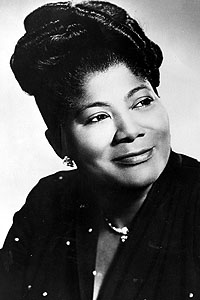
Mahala “Halie” Jackson was born on October 26, 1911, in New Orleans, Louisiana. Jackson loved to sing, especially in church, and that is where her singing career began – at the local Mount Moriah Baptist Church.
In 1927, at the age of 16, Jackson moved to Chicago, Illinois, during the Great Migration. After her first Sunday school service, where she had given an impromptu performance of her favorite song, "Hand Me Down My Silver Trumpet, Gabriel", she was invited to join the Greater Salem Baptist Church Choir. She began touring with the Johnson Gospel Singers, one of the earliest professional gospel groups.
She refused to sing secular music, a pledge she would keep throughout her professional life although she was frequently offered money to do so. She even divorced her first husband because of his unrelenting pressure on her to sing worldly music.
"I sing God's music because it makes me feel free", Jackson once said about her choice of gospel, adding, "It gives me hope. With the blues, when you finish, you still have the blues."
In 1948, Jackson recorded the William Herbert Brewster song "Move On Up a Little Higher", a recording so popular stores could not stock enough copies to meet demand. The success of this record rocketed her to fame in the U.S., and soon after, in Europe. During this time, she toured as a concert artist, appearing more frequently in concert halls and less often in churches. Because of this change in her venues, her arrangements expanded from piano and organ to orchestral accompaniments.
In 1950, Jackson became the first gospel singer to perform at Carnegie Hall. She started touring Europe in 1952 and was hailed by critics as the "world's greatest gospel singer." With her mainstream success, Jackson was criticized by some gospel purists who complained about her hand-clapping and foot-stomping and about her bringing jazz into the church. But that didn’t stop Jackson, she went on to have many noticeable accomplishments, such as singing for at John F. Kennedy's inaugural ball, singing at the March on Washington, and singing at the funeral of Martin Luther King Jr.
Jackson played an important role during the civil rights movement. She was contacted by Martin Luther King Jr and Ralph Abernathy about singing at a rally in Montgomery to raise funds for the bus boycott. Despite death threats, Jackson agreed to sing. There was a good turnout at the concert and they were happy with the amount of money raised. However, when they returned to the Abernathy's home, it had been bombed. Jackson said that she hoped her music could "break down some of the hate and fear that divide the white and black people in this country.”
Jackson devoted much of her time and energy to helping others. She established the Mahalia Jackson Scholarship Foundation for young people who wanted to attend college. For her efforts in helping international understanding, she received the Silver Dove Award. Jackson was described by Harry Belafonte as "the single most powerful black woman in the United States," and anyone who can claim that title deserves recognition to me.
With the NCAA’s March Madness quickly making its way to its conclusion, I decided to take part in brackets that piqued my interest. Enter, Kanye Madness.
Twitter user Carrington Harrison (@cdotharrison) strategically built this Kanye Madness Bracket with care in mind, by forcing formidable Kanye hits to go head-to-head. The 64-song bracket split some of the best music into 4 regions: North West, Donda, Chicago, and Saint.
He’s already finished up Kanye Madness on his twitter page. I’m not gonna tell you who won! But you can find it here. What I can say is that my love for “The Old Kanye” seems to run DEEP. But I could also respect the juxtaposition that I saw in the earlier rounds with the song match-ups. Either song, both from different albums and different “Kanyes,” could focus on the same theme in a with a different sound.
I more so did this bracket to figure out what I would consider my favorite Kanye songs. I could listen to my Elite 8 on repeat for the rest of my life, I suppose. Print it out and do it yourself and be sure to check out @cdotharrison twitter page or use search the hashtag #KanyeMadnessBracket to see how your bracket held up against Harrison’s and others who have shared.
The youngest child of the Quintanilla family, Selena became the lead singer in her family's band, Selena Y Los Dinos. The musical group started out playing weddings and clubs in their native Texas. Her father, Abraham, a former musician, managed and produced the group. Selena grew up speaking English, but her father taught her to sing in Spanish so she could resonate with the Latino community. Selena began recording professionally in 1982. In the 1980s, she was often criticized and was refused bookings at venues across Texas for performing Tejano music—a male-dominated music genre. However, her popularity grew after she won the Tejano Music Award for Female Vocalist of the Year in 1987, and for nine consecutive years after.
Selena released her self-titled debut album on October 17, 1989. Selena peaked at number seven on the US Billboard Regional Mexican Albums chart, becoming Selena's first recording to debut on a national music chart. The album performed better than other recordings from other contemporaneous female Tejano singers. That same year, she became Coca-Cola’s spokesperson.
In September 1990, Selena released her second studio album, Ven Conmigo. One of its singles, “Baila Esta Cumbia” became one of Selena's most successful single. It was around that time that Yolanda Saldívar asked the Quintanilla family about starting a fan club for Selena. In hopes of bringing more attention to the band, they agreed.
Against her father’s will, Selena eloped with Chris Pérez, the band’s guitarist. A month later, Selena released her breakthrough album, Entre a Mi Mundo. The recording peaked at number one on the US Billboard Regional Mexican Albums chart for eight consecutive months; it was certified 6x platinum by the RIAA. Entre a Mi Mundo became the first Tejano album by a female artist to sell over 300,000 copies. "Como la Flor" became Selena's signature recording; it helped Selena to dominate the Latin music charts and become immensely popular in Mexico.
In 1994 Selena began designing and manufacturing a line of clothing; she opened two boutiques called Selena Etc., one in Corpus Christi and the other in San Antonio. Both were equipped with in-house beauty salons. Saldívar managed both boutiques after the Quintanilla family were impressed with the way she managed the fan club. Hispanic Business magazine reported that the singer earned over five million dollars from these boutiques. She was ranked among the twentieth-wealthiest Hispanic musicians who grossed the highest income in 1993 and 1994.
Amor Prohibido became one of the best-selling Latin albums in the United States and has been certified 2x diamond by the RIAA. “Bidi Bidi Bom Bom” was one of my favorites that went number one from this album. Amor Prohibido popularized Tejano music among a younger and wider audience than at any other time in the genre's history. Billboard magazine ranked Amor Prohibido among the most essential Latin recordings of the past 50 years and included it on its list of the top 100 albums of all-time.
It was discovered that Saldívar had embezzled more than $30,000 via forged checks from both the fan club and the boutiques. Selena's father presented Saldívar with the inconsistencies concerning the disappeared funds. He told her that if she did not provide evidence that disproved his accusations, he would involve the local police. Saldívar also began to show obsessive tendencies with Selena. So much to the point that Mr. Quintanilla Jr. forbade Saldívar from contacting Selena. It was as if Saldívar refused to stay out of Selena's life.
Saldívar delayed handing over the bank statements and financial records with many outrageous stories. And when Selena met up with her at a Days Inn to demand the financial paperwork, Saldívar shot Selena. She was pronounced dead upon arriving at the hospital.
Selena's murder had a widespread impact. Her death was front-page news in The New York Times for two days. Numerous vigils and memorials were held in her honor, and radio stations in Texas played her music non-stop. Her funeral drew 60,000 mourners, many of whom traveled from outside the United States. On April 12, 1995, two weeks after Selena's death, George W. Bush, governor of Texas at the time, declared her birthday, April 16, Selena Day in the state. He said Selena represented "the essence of south Texas culture."
Aside from music, Selena was active in her community and donated her time to civic causes. During her childhood, Selena helped organizations such as Toys for Tots. She was active in the U.S. Latino community, visiting local schools to talk to students about the importance of education. he also donated her time to civic organizations such as D.A.R.E. and planned a fund-raising concert to help AIDS patients.
Selena has been credited for helping redefine Latin music by breaking barriers in the Latin music world. She is considered "one of the most significant Mexican American singers of the end of the twentieth century" and her death was "the most devastating loss" in Tejano music history – the Tejano market died with her. But her memory and her legacy lived on through the music that she has left behind. And who knows? One day, a little girl may hear that music and decide to bring Tejano music back to life.